
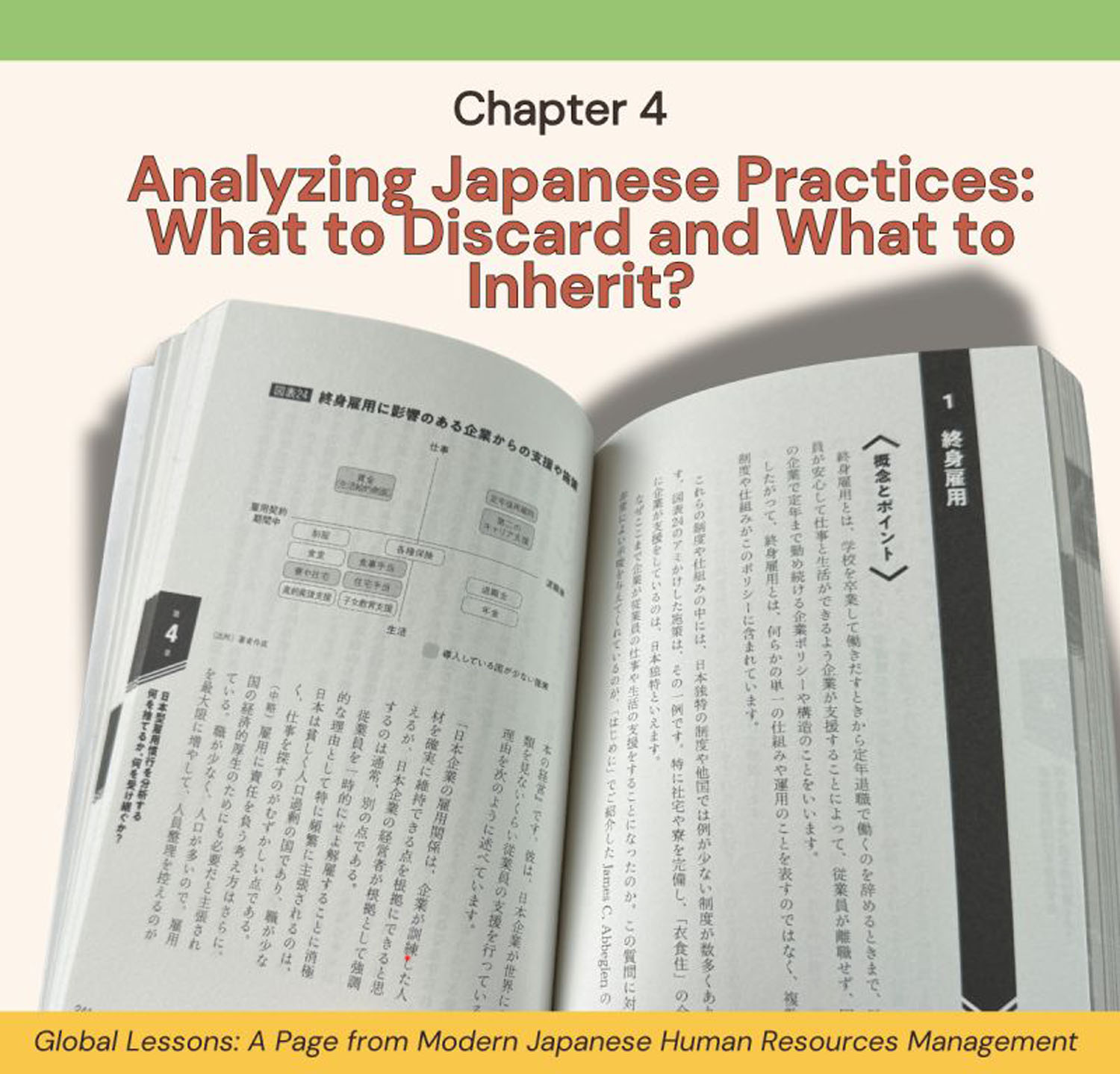
Japanese-style employment practices have long been credited with supporting Japan’s postwar economic growth. That history is the starting point for this chapter of my book「グローバル企業のための新日本型人材マネジメントのすすめ」Global Lessons: A Page from Modern Japanese Human Resources Management.
This chapter focuses on a practical question: which elements of traditional Japanese employment practices should be carried forward and which should be changed or let go. Rather than treating these practices as something to preserve as they are, the chapter examines them more critically.
I analyze the five core policies that shaped Japanese-style employment and look at how they actually functioned in practice. Some ideas remain relevant. Others have produced unintended outcomes, often due to how they were applied rather than the ideas themselves. This chapter separates those two and looks at the root causes.
The aim is not to return to the past, but to extract the principles that supported employee motivation and organizational growth and redefine them for today’s business environment. From that analysis, the chapter introduces the concept of a new Japanese-style human resource management that can work in a very different future.
For those interested, you can find the book here:
https://lnkd.in/gt4VSvHa